
3PL Fulfillment Invoice Audit: How Ecommerce Brands Verify Warehouse Billing
By Umer Nalir, Founder & CEO of ProActiveChain
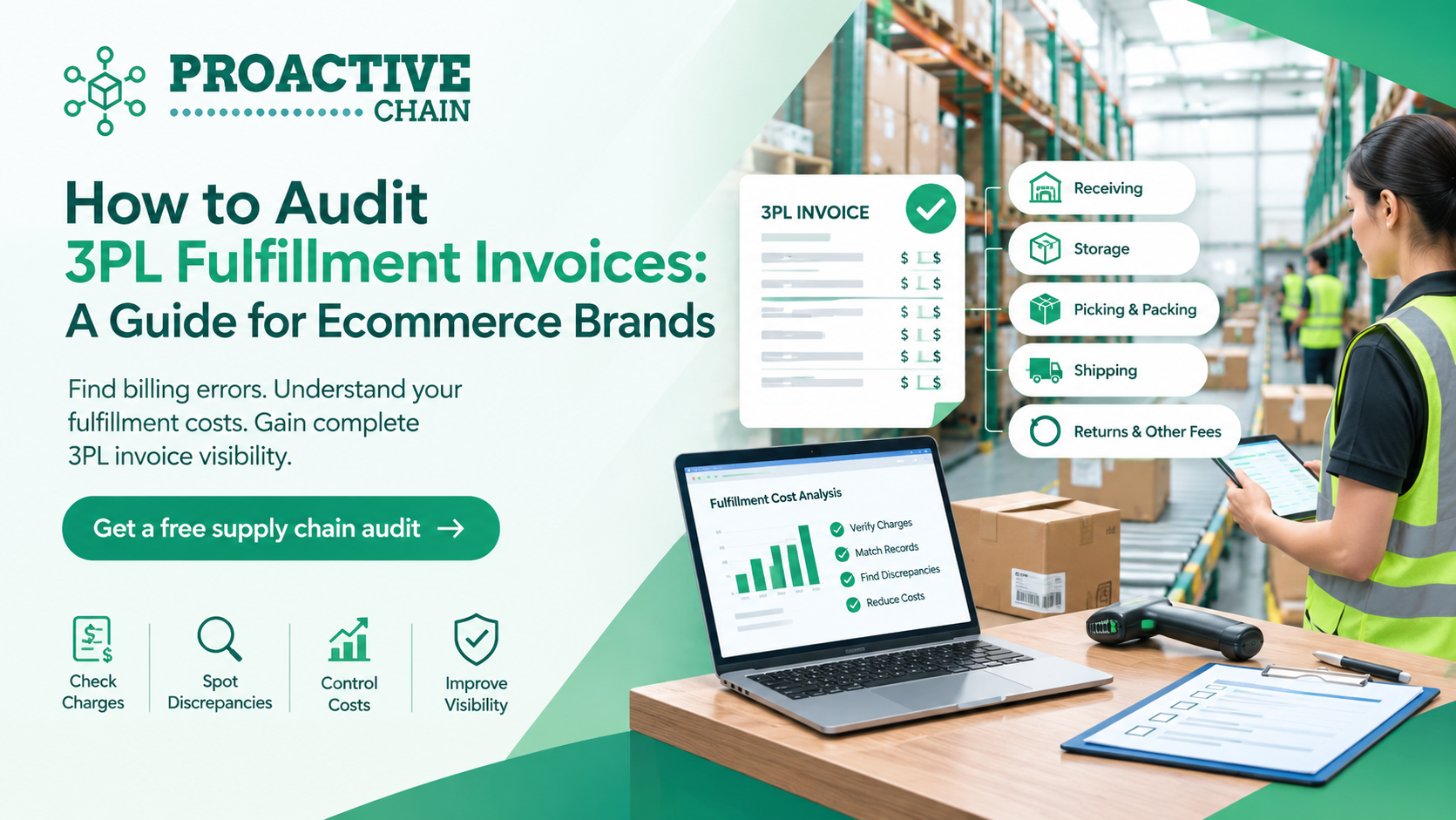
A 3PL fulfillment invoice audit is the process of verifying that warehouse and fulfillment charges match your agreed contract, warehouse activity, shipment records, and fulfillment data. It helps ecommerce brands understand what they are paying for, identify billing discrepancies, and improve visibility into fulfillment costs.
For growing Amazon sellers and DTC brands, a 3PL invoice is rarely just one fulfillment fee. It can include receiving, storage, picking, packing, packaging, returns, special handling, shipping, software, account management, and seasonal charges. When these charges are not connected to operational data, it becomes difficult to know whether rising costs are caused by higher volume, changed order profiles, warehouse activity, or billing issues.
A fulfillment invoice audit does not mean assuming every charge is wrong. It means creating a repeatable process to verify charges, investigate differences, and hold your 3PL accountable to the agreed service terms.
Why Should Ecommerce Brands Audit 3PL Fulfillment Invoices?
Ecommerce brands should audit 3PL fulfillment invoices to connect warehouse billing with real operational activity.
A 3PL may manage inbound receiving, inventory storage, order fulfillment, returns, and outbound shipping. Each activity can be billed differently depending on your agreement. Without a structured review, finance and operations teams may see different versions of fulfillment performance: operations sees orders shipped, while finance sees an invoice total that is difficult to explain.
A fulfillment invoice audit helps you answer practical questions such as:
-
Are we being billed according to the agreed rate card?
-
Can each major charge be linked to a receiving, inventory, order, or shipment record?
-
Are fulfillment costs rising because of volume, product mix, storage needs, or billing changes?
-
Are recurring discrepancies being resolved?
-
Is our 3PL meeting the service levels our customers expect?
The objective is not simply to reduce every invoice. It is to create clear cost visibility and a measurable relationship with your fulfillment provider.
What Should a 3PL Fulfillment Invoice Audit Include?
A complete 3PL fulfillment invoice audit should review both the invoice and the operational records that support it.
Before you begin, collect:
-
The current 3PL contract and signed rate card
-
Contract amendments or approved pricing changes
-
Itemized invoices for the review period
-
Order-management data
-
Warehouse management system reports
-
Receiving and inventory reports
-
Shipment or carrier records
-
Returns reports
-
Approved special-service requests
Use records from the same billing period. Comparing a monthly invoice with data from a different date range can create misleading differences.
Which Fulfillment Charges Should You Review?
Receiving and inbound handling
Compare receiving charges with inbound receipts, purchase orders, cartons, pallets, or units received. Confirm that the billing method matches your agreement.
Ask:
-
Were the billed receiving quantities actually received?
-
Does the charge follow the agreed per-pallet, per-carton, per-unit, or other billing method?
-
Were additional handling services authorized and documented?
Storage and inventory charges
Storage charges should be reviewed alongside inventory levels, storage duration, and the agreed billing unit.
Check:
-
Pallet, bin, shelf, or cubic-volume billing units.
-
Storage period and billing dates.
-
Long-term storage thresholds.
-
Inventory adjustments, returns, damaged goods, and disposals.
-
Whether inventory levels support the billed storage amount.
A storage increase does not automatically mean an error. It may reflect slower inventory turnover, seasonal stock builds, oversized products, or a change in storage requirements.
Pick, pack, and order fulfillment
Compare pick-and-pack charges with processed orders, units shipped, and warehouse activity.
Review:
-
Number of orders billed.
-
Number of units or picks billed.
-
Multi-item order pricing.
-
Packaging upgrades.
-
Kitting, bundling, inserts, and special handling.
-
Orders canceled before fulfillment.
-
Duplicate order or invoice lines.
Make sure you know which activities are included in the base fulfillment rate and which are billed separately.
Shipping and carrier-related charges
Shipping charges should be reviewed against shipment records, tracking numbers, service levels, package details, and applicable carrier terms.
Check:
-
Shipment dates and tracking numbers.
-
Destination zones and service levels.
-
Package weight and dimensions.
-
Chargeable weight and dimensional-weight calculations.
-
Fuel, residential, remote-area, address-correction, and other accessorial charges.
-
Whether carrier charges were passed through correctly.
A higher shipping invoice may be valid if shipment volume, destinations, package sizes, or service levels changed. The audit should establish the reason for the change.
Returns and additional services
Returns, relabeling, repacking, kitting, disposal, and special projects can create additional charges.
Confirm that:
-
The service was performed.
-
The service was requested or permitted by the agreement.
-
The billing rate matches the contract.
-
Supporting records exist for the work completed.
-
Return quantities and dispositions match your returns report.
How to Perform a 3PL Fulfillment Invoice Audit
Step 1: Gather the invoice and source records
Collect the invoice, contract, rate card, order data, warehouse reports, inventory reports, shipment records, and approved service requests for the same period.
Step 2. Reconcile charges with warehouse activity
Match each major charge category to the record that should support it:
-
Receiving charges to inbound receipts.
-
Storage charges to inventory reports.
-
Pick-and-pack charges to processed orders.
-
Shipping charges to shipment records.
-
Returns charges to returns reports.
Step 3. Recalculate charges using the contract
Use the agreed rates and billing rules to check the invoice calculation.
For example, if your contract charges $2 per order for a service and 1,000 eligible orders were processed, the expected charge is $2,000 before other applicable fees or adjustments. Your actual contract determines the correct calculation.
Step 4. Document discrepancies
Create an exception log for every charge that cannot be reconciled. Include:
-
Invoice number.
-
Charge description.
-
Billing amount.
-
Expected amount or calculation.
-
Supporting evidence.
-
Question for the 3PL.
-
Owner and resolution status.
Do not label every unexplained charge as an overcharge. It may be a timing difference, contract change, integration issue, or valid additional service.
Step 5. Request clarification or correction
If the evidence shows that a charge conflicts with the contract or operational records, send a specific written query to your 3PL.
Include the invoice line, contract reference, supporting record, amount in question, and the correction or clarification you are requesting.
Step 6. Track recurring issues
Review whether the same discrepancy appears across multiple invoices. Repeated issues may indicate unclear pricing rules, data integration problems, inconsistent reporting, or a process that needs improvement.
Agree on corrective actions with your provider and verify that the issue does not continue in future billing periods.
How Do You Measure Fulfillment Cost Performance?
Invoice accuracy is only one part of fulfillment cost control. Use consistent metrics to understand whether costs are changing because of operational activity or billing issues.
Useful metrics include:
-
Fulfillment cost per order: Total defined fulfillment costs divided by orders fulfilled in the same period.
-
Fulfillment cost as a percentage of sales: Defined fulfillment costs divided by net sales, multiplied by 100.
-
Storage cost trend: Storage charges reviewed alongside inventory levels and billing rules.
-
Shipping cost per shipment: Relevant shipping charges divided by shipments in the same period.
-
Invoice discrepancy rate: Invoice lines requiring investigation divided by total invoice lines reviewed, multiplied by 100.
-
Dispute resolution time: Time taken to resolve a billing query or documented discrepancy.
Use the same cost definition each month. If one month includes storage and receiving while another includes only pick-and-pack, the results will not be comparable.
How Can You Prevent Recurring Fulfillment Billing Problems?
A one-time audit can identify issues in a single invoice. A repeatable process prevents the same questions from returning every month.
Put these controls in place:
-
Keep the current rate card and contract accessible to the invoice-review team.
-
Document approved pricing changes and their effective dates.
-
Review invoices before payment deadlines.
-
Use consistent order, inventory, shipment, and returns reports.
-
Assign clear ownership for reviewing charges and resolving disputes.
-
Track disputed amounts, credits, and unresolved items.
-
Review fulfillment performance alongside billing performance.
When Should You Review Your 3PL Billing Process?
Review your fulfillment billing process when:
-
Fulfillment spend rises unexpectedly.
-
You add a new sales channel.
-
Order volume changes significantly.
-
A new pricing agreement begins.
-
Your 3PL introduces new services or surcharges.
-
You transition warehouses or 3PL providers.
-
Finance and operations cannot reconcile fulfillment records.
A review is especially valuable after a warehouse transition, when billing structures and operational data may not yet be fully aligned.
How ProActiveChain Helps With 3PL Fulfillment Oversight
Managing a 3PL involves more than sending inventory to a warehouse. Ecommerce brands also need visibility into fulfillment performance, billing, service expectations, and recurring operational issues.
ProActiveChain provides 3PL setup and fulfillment oversight, including support with provider selection, service-level agreements, performance metrics, regular reviews, billing audits, and dispute resolution.
A structured oversight process can help ecommerce teams connect warehouse activity with financial and operational reporting, identify questions that need investigation, and hold service providers accountable to agreed expectations.
For a broader guide to reviewing invoice line items and identifying potential hidden fees, read our guide on how to audit 3PL invoices for hidden fees.
Frequently Asked Questions
What is a 3PL fulfillment invoice audit?
A 3PL fulfillment invoice audit is a review of warehouse and fulfillment charges against your contract, rate card, order data, inventory records, and shipment information.
How is a fulfillment invoice audit different from a general 3PL invoice audit?
A fulfillment invoice audit focuses on connecting warehouse activity—such as receiving, storage, picking, packing, returns, and shipping—to billing. A general 3PL invoice audit may also review contract terms, rate cards, and fee disclosures in more detail.
How often should ecommerce brands audit fulfillment invoices?
Monthly is a practical starting point for many ecommerce businesses. Higher-volume brands, multi-warehouse operations, or businesses with complex pricing may need more frequent reviews.
What records do I need for a fulfillment invoice audit?
You need the invoice, contract, rate card, order data, receiving records, inventory reports, shipment records, returns reports, and approved special-service requests.
Can a fulfillment invoice audit reduce costs?
It can identify charges that need correction and reveal cost patterns worth investigating. Actual savings depend on the discrepancies found, your contract, and the corrective actions taken.
Get Better Visibility Into Your Fulfillment Costs
Unexplained fulfillment charges can make it difficult to understand your true operating costs. A consistent 3PL fulfillment invoice audit helps your team verify billing, investigate discrepancies, and build a clearer picture of fulfillment performance.
Want to improve your 3PL oversight and identify opportunities to strengthen your supply chain operations?
Request a free ProActiveChain supply chain audit to discuss your current process and potential areas for improvement.