
Ecommerce Returns Management: Build a Better Returns Process
By Umer Nalir, Founder & CEO of ProActiveChain
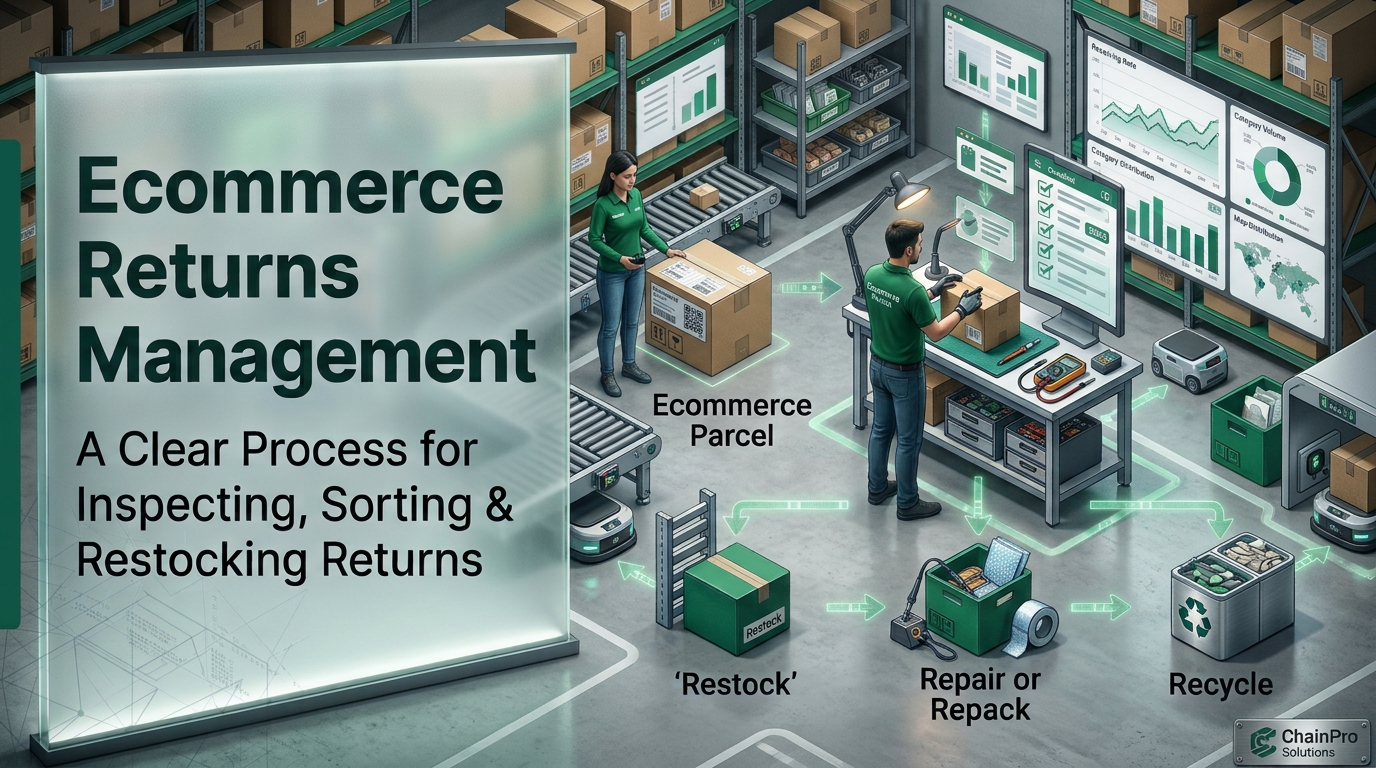
Ecommerce returns management is the process of authorizing, receiving, inspecting, sorting, and processing products customers send back. A clear returns workflow helps ecommerce brands recover sellable inventory, identify product problems, control reverse logistics costs, and keep inventory records accurate. The goal is to move every returned product to the right destination while maintaining visibility from the return request to final resolution.
How Does Ecommerce Returns Management Work?
An effective ecommerce returns management process follows a consistent sequence. Each step should have a clear owner, a documented outcome, and a way to update inventory records.
- Authorize the return: Check the order, return window, product eligibility, and applicable return policy.
- Record the return: Create a return merchandise authorization (RMA) or equivalent return record when your process requires one.
- Receive the product: Match the returned parcel to the correct order and return record.
- Inspect the item: Check its condition, packaging, accessories, and any reported defect.
- Choose the next action: Decide whether to restock, repackage, repair, quarantine, return to the supplier, or dispose of the product.
- Update inventory and resolve the customer case: Record the final disposition, process the applicable refund or exchange, and close the return when all required steps are complete.
The exact workflow depends on the product, return policy, sales channel, and warehouse capabilities. The important requirement is that a return does not disappear between customer service, the warehouse, and inventory management.
How Can You Build an Effective Ecommerce Returns Management Process?
A reliable returns process begins before a product arrives back at the warehouse. Your team needs clear rules for approving returns, collecting information, and assigning responsibility.
Set clear ecommerce return authorization rules
Document which products can be returned, the applicable return window, required proof of purchase, and any product-specific conditions. Explain how your team handles damaged items, incorrect shipments, exchanges, and exceptions.
Make the policy easy for customers and staff to understand. If different sales channels have different requirements, document those differences rather than assuming one rule applies everywhere.
For example, an order placed through your Shopify store may follow a different return workflow from an order fulfilled through a marketplace. Your team should confirm the relevant order and channel before approving the return.
Shopify provides guidance on managing returns through its platform: https://help.shopify.com/en/manual/fulfillment/managing-orders/returns
Record every ecommerce return consistently
Create a return record that connects the original order to the returned product and its final outcome. Depending on your operation, useful fields may include:
- Original order number and sales channel.
- SKU, product name, and quantity returned.
- Return request date and receipt date.
- Customer-reported reason for return.
- Return authorization or case reference.
- Inspection result and product condition.
- Final disposition and inventory adjustment.
- Refund, exchange, or replacement status.
- Any supplier, carrier, or warehouse follow-up required.
Use consistent return-reason categories across customer service and warehouse operations. Categories such as damaged on arrival, incorrect item, sizing or fit, unwanted purchase, and product not as described can help reveal recurring issues.
Keep customer information limited to what is necessary for processing and resolving the return.
What Should You Check When Inspecting Ecommerce Returns?
A returned product should not automatically be treated as sellable inventory. It must first pass the checks appropriate to that product and your quality requirements.
Use a consistent returned-product inspection checklist
When a return arrives, the warehouse team should:
- Match the parcel and product to the return record.
- Confirm the SKU and quantity received.
- Inspect the product for damage, wear, contamination, or signs of use.
- Check packaging, labels, accessories, and included components.
- Compare the condition with the customer’s reported return reason.
- Photograph damage or unusual conditions when documentation is needed.
- Record the inspection result and recommended disposition.
The inspection criteria should reflect the product being handled. Electronics, cosmetics, clothing, and home goods may require different checks. For example, an item with missing components may need to be held for review instead of being returned directly to available stock.
Do not use a single inspection standard for every product if safety, hygiene, warranty, or resale requirements differ.
How Should You Sort and Process Returned Products?
After inspection, every returned product needs a defined destination. This decision is known as product disposition. Clear disposition rules help prevent unsellable goods from being mixed with available inventory.
Restock products that meet resale requirements
Return eligible products to available inventory only after the required inspection and documentation are complete. Confirm that the SKU, quantity, condition, and stock location are correct.
If your business separates sellable, damaged, reserved, and returned inventory, use the appropriate status or location. This helps prevent a returned product from being promised to another customer before it is ready for sale.
Repackage or repair products when appropriate
Some products may be suitable for resale after cleaning, repackaging, replacing missing components, or completing an approved repair.
Before assigning this route, confirm that the work is permitted, financially reasonable, and consistent with product safety and resale requirements. Record any work completed and verify the product again before making it available for sale.
Quarantine, return to the supplier, or dispose of unsuitable products
Products with unresolved defects, suspected safety issues, contamination, or uncertain condition should be held separately while the appropriate decision is made.
Depending on the circumstances, the next action may be supplier investigation, a warranty claim, an approved return-to-vendor process, recycling, or disposal. Follow applicable product, environmental, and safety requirements.
Record the reason for the decision so your team can distinguish normal customer returns from supplier quality problems and warehouse handling issues.
How Can You Reduce Ecommerce Returns Processing Costs?
Returns costs can come from reverse shipping, warehouse handling, inspection, repackaging, customer service, refunds, and inventory that cannot be resold. Reducing these costs starts with understanding where time and value are lost.
Identify the main causes of returns
Review return reasons by SKU, product category, supplier, sales channel, and time period. Look for recurring patterns rather than treating every return as an isolated event.
For example, repeated complaints about a product’s dimensions may indicate that product-page measurements need improvement. A pattern of damaged items may require a closer look at packaging, supplier quality, or transport handling.
Use verified return records to decide which problems deserve attention first.
Reduce delays between receipt and disposition
Set clear responsibilities for receiving, inspection, inventory updates, and customer resolution. Track products that remain in a returned or quarantined status without a documented next step.
A simple exception queue can help your team identify returns awaiting inspection, supplier approval, repair, or a refund decision. Assign an owner and a follow-up date to each unresolved case.
Avoid unnecessary handling
Where practical, organize returned products so warehouse staff can identify the correct SKU, inspect it, record the outcome, and move it to the appropriate location without repeated handling.
Agree on standard inspection requirements with your fulfillment partner. Clear instructions can reduce inconsistent decisions and prevent unnecessary transfers between warehouse areas.
Which Ecommerce Returns Management Metrics Should You Track?
Returns metrics help you understand how efficiently your process operates and where improvements may be needed. Define each metric consistently before comparing performance across periods or warehouses.
Track returns processing time
Measure the time between a defined starting point and a defined completion point. For warehouse processing, this might be the time from physical receipt to recorded disposition.
Keep customer refund time separate from warehouse processing time when the two are controlled by different teams or systems.
Measure the exception rate
Track the share of returns that require action outside the standard workflow, such as missing authorization details, incorrect products, damaged parcels, or unresolved inspection results.
A high or rising exception rate may indicate unclear procedures, incomplete records, supplier problems, or recurring fulfillment errors. Investigate the reasons before deciding on corrective action.
Monitor the resalable recovery rate
Measure how much returned inventory becomes eligible for resale after inspection and any required processing.
One possible formula is:
Resalable recovery rate = Units approved for resale ÷ Total units inspected × 100
Define whether repaired or repackaged units count as resalable, and use the same definition in every reporting period.
Calculate cost per return
A practical cost-per-return measure is:
Cost per return = Total included return-processing costs ÷ Number of returns processed
Specify which costs are included, such as return freight, warehouse labor, inspection, repackaging, and customer service. Keep the scope consistent so changes over time are meaningful.
Review repeat return reasons
Monitor recurring return reasons by SKU, product category, supplier, and channel. Use the findings to prioritize improvements to product descriptions, quality checks, packaging, or fulfillment procedures.
Do not rely on a single metric. Faster processing is not an improvement if it leads to incorrect inventory updates or unsuitable products being returned to sale.
How Should Your 3PL Handle Ecommerce Returns?
If a third-party logistics provider (3PL) processes returns, define its responsibilities in writing. Your agreement and operating procedures should explain which tasks the 3PL performs and which decisions remain with your business.
Clarify:
- How returned parcels are identified and received.
- Which inspection checks warehouse staff must complete.
- How product condition and return reasons are recorded.
- Which inventory statuses and locations are used.
- When the 3PL must request approval before repair, disposal, or supplier return.
- How quickly return records and exceptions are reported.
- Who investigates discrepancies between physical stock and system records.
Request return-level records that allow your team to trace each product from receipt through final disposition. Agree on reporting frequency, exception escalation, and the evidence required to resolve disputed cases.
If you are reviewing a fulfillment partner’s overall processes, see ProActiveChain’s guide to comparing 3PLs before moving your ecommerce inventory.
For related guidance on stock record accuracy, read 3PL inventory discrepancies.
Shopify also explains how to process returns within its platform: https://help.shopify.com/en/manual/fulfillment/managing-orders/returns/processing-returns
What Should Your Ecommerce Returns Management Checklist Include?
Use this checklist to review your current process and identify missing controls.
- Document return eligibility rules and exceptions for each relevant sales channel.
- Connect every return to its original order and SKU.
- Record the return reason, quantity, dates, and case reference.
- Inspect returned products using product-appropriate criteria.
- Separate sellable stock from damaged, quarantined, or uninspected items.
- Document the final disposition and update inventory records.
- Track unresolved cases and assign an owner to each exception.
- Reconcile physical returned inventory with system records.
- Review processing time, exception rate, resalable recovery rate, and cost per return.
- Use recurring return reasons to improve product information, supplier quality, packaging, and fulfillment procedures.
- Confirm that any 3PL handling returns follows documented procedures and reporting requirements.
Frequently Asked Questions About Ecommerce Returns Management
What is ecommerce returns management?
Ecommerce returns management is the process of handling products customers send back, from return authorization and warehouse receipt to inspection, inventory updates, refunds or exchanges, and final product disposition.
How can an ecommerce business improve its returns process?
Start by documenting return rules, standardizing inspection criteria, recording each product’s final disposition, and tracking exceptions. Review recurring return reasons to identify improvements in product information, supplier quality, packaging, and fulfillment.
Should returned products go straight back into inventory?
No. Returned products should first be checked against the appropriate inspection and resale requirements. Only eligible products should be returned to available inventory; other items may need repair, repackaging, quarantine, supplier review, or disposal.
What should a 3PL report about ecommerce returns?
Agree on reporting that covers returned quantities, receipt dates, inspection outcomes, product condition, inventory adjustments, final disposition, and unresolved exceptions. The precise reporting requirements should reflect the products, systems, and services involved.
Which metrics help measure returns management performance?
Useful measures include warehouse processing time, exception rate, resalable recovery rate, cost per return, and recurring return reasons. Define each measure consistently and use the results to identify operational improvements.
Improve Your Ecommerce Returns Management Process
A reliable returns process requires more than accepting parcels and issuing refunds. Ecommerce brands need clear inspection rules, accurate inventory records, documented disposition decisions, and visibility into unresolved cases.
ProActiveChain helps ecommerce businesses improve supply chain processes, inventory visibility, and fulfillment operations. If returned inventory is creating extra work, stock inaccuracies, or avoidable costs, a review of your current workflow can help identify where better controls are needed.