
How Much Inventory Should an Ecommerce Brand Hold Without Killing Cash Flow?
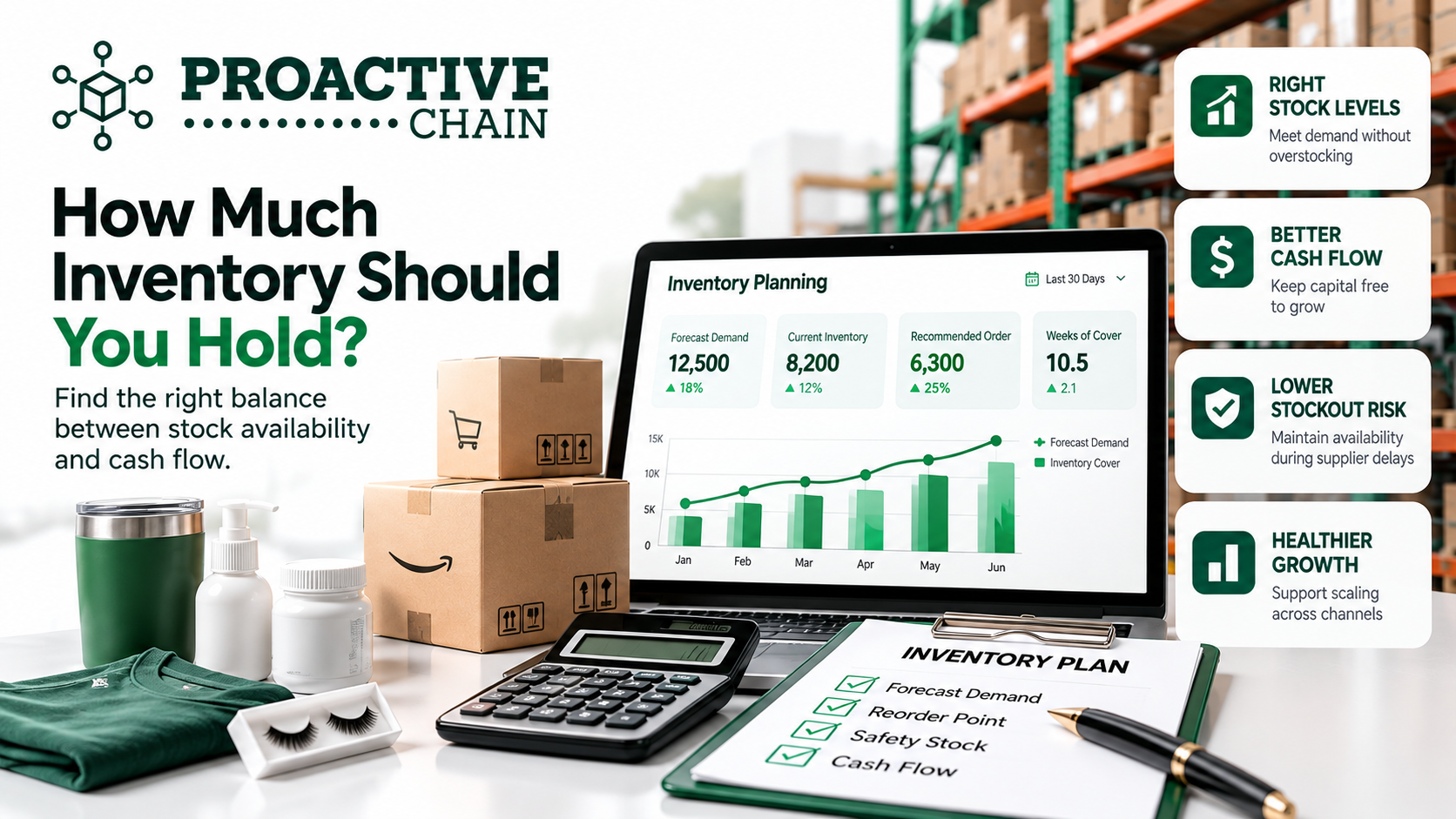
By Umer Nalir, Founder & CEO of ProActiveChain
Growing ecommerce brands often assume inventory problems mean one thing: running out of stock.
But holding too much inventory can be just as damaging.
Holding too little inventory increases your risk of ecommerce stockouts, while holding too much can trap significant working capital in products sitting on warehouse shelves.
Every unit of inventory represents cash that has already left your bank account.
That cash cannot be used for marketing, new product development, hiring, expansion, or replenishing the products that are actually selling fastest.
So, how much inventory should an ecommerce brand actually hold?
There is no universal answer.
The right inventory level depends on your forecast demand, supplier lead time, freight transit time, safety stock requirements, confirmed inbound inventory, sales volatility, and the importance of each SKU to your business.
The goal is not to hold as much inventory as possible.
The goal is to hold the right inventory, in the right quantity, at the right time, without unnecessarily tying up cash.
Why Too Much Inventory Is a Cash Flow Problem
Inventory appears as an asset on the balance sheet, but operationally it is cash that has already been committed.
Imagine an ecommerce brand buys $300,000 worth of inventory.
If half of that stock will not sell for another six months, approximately $150,000 of working capital is sitting in products rather than being available to grow the business.
That can create several problems:
- Less cash available for new purchase orders
- Reduced marketing budget
- Difficulty funding fast-selling products
- Higher warehouse storage fees
- Increased risk of obsolete stock
- More discounting to clear slow-moving products
- Greater pressure on cash during growth periods
This is why inventory planning should not be treated as purely an operations function.
It is also a cash flow and working-capital function.
A brand can be profitable on paper and still experience cash pressure because too much money is tied up in inventory.
How Much Inventory Should an Ecommerce Brand Hold?
A better way to think about inventory is in weeks of cover rather than simply counting units or deciding that every product needs three months of stock.
Weeks of cover tells you approximately how long your available inventory will last based on forecast demand.
The basic calculation is:
Weeks of Cover = Available Inventory ÷ Forecast Weekly Demand
For example, if you have:
- 6,000 units available
- Forecast demand of 1,000 units per week
You have approximately:
6 weeks of inventory cover
Whether six weeks is healthy depends on how quickly you can replenish the product.
If your supplier can manufacture and deliver new inventory within four weeks, six weeks may be comfortable.
If replenishment takes twelve weeks, six weeks means you may already be heading toward a stockout.
Inventory therefore needs to be planned against replenishment lead time, not an arbitrary number of months.
The 5 Variables That Determine How Much Inventory You Need
1. Forecast Demand
Inventory planning should begin with expected future demand.
One of the easiest mistakes to make is assuming that the next 30 days will look exactly like the previous 30 days.
Growing ecommerce brands rarely behave that predictably.
Demand can change because of:
- Advertising spend
- Promotions
- Influencer campaigns
- Seasonality
- New retail accounts
- Amazon ranking changes
- Product launches
- International expansion
- Changes in conversion rate
- Competitor activity
At ProActiveChain, we look at multiple sales velocities rather than relying on a single average.
That can include:
- 7-day velocity
- 14-day velocity
- 30-day velocity
- 60-day velocity
- 90-day velocity
The purpose is to understand whether demand is stable, accelerating, slowing down, or temporarily distorted.
For example, if a product sold:
- 1,800 units over the last 90 days
- 900 units over the last 30 days
- 500 units over the last 14 days
- 280 units over the last 7 days
The recent sales pattern may suggest that demand is accelerating.
If purchasing continues using the 90-day average, the brand could underestimate how quickly inventory will disappear.
The opposite can happen after a promotion.
If a major sale creates a temporary spike and the business assumes that demand will continue indefinitely, it can over-order and trap cash in stock.
Forecasting needs context.
2. Total Replenishment Lead Time
The second variable is how long it takes to replace inventory.
Many ecommerce brands focus only on factory production time.
That is not enough.
Your true replenishment lead time may include:
PO approval → raw material purchasing → production → quality control → packing → freight booking → export handling → transit → customs → warehouse delivery → receiving
If manufacturing takes 30 days but shipping, customs, and receiving require another 30 days, your actual replenishment cycle is closer to 60 days.
Inventory planning should therefore be based on when the goods become available to sell, not simply when the supplier says production will be complete.
This becomes even more important when sourcing internationally.
Production delays, rolled cargo, port congestion and other shipping delays from China can extend your actual replenishment cycle well beyond the original supplier estimate.
A brand that plans inventory using a 45-day lead time when the real average is closer to 65 days is building a stockout risk directly into its purchasing model.
Your planning should reflect how suppliers and freight routes actually perform, not just the best-case dates written on the purchase order.
3. Safety Stock
Safety stock protects the business when reality does not match the plan.
Demand may suddenly increase.
A supplier may finish production late.
A container may be rolled to a later vessel.
Customs may delay a shipment.
Your 3PL may take longer than expected to receive the stock.
Safety stock exists to absorb these variations.
However, safety stock should not simply be a random percentage added to every SKU.
The amount should reflect the risk associated with that particular product.
A larger buffer may make sense when:
- The SKU generates a large percentage of revenue
- Supplier lead times fluctuate
- Demand is volatile
- There is no backup supplier
- Ocean freight is being used
- The product takes a long time to replenish
- A stockout could damage Amazon ranking
- A major promotion is approaching
- Peak season is approaching
- Production overlaps with major factory holidays
A smaller buffer may be appropriate when:
- Demand is stable
- Replenishment is fast
- The supplier is highly reliable
- The product has lower revenue impact
- Emergency replenishment is relatively easy
The objective is not to eliminate every possible inventory risk.
It is to balance:
Stockout risk ↔ Working-capital risk
Holding too little safety stock can create lost sales.
Holding too much can leave large amounts of cash sitting idle in a warehouse.
4. Confirmed Inbound Inventory
Current warehouse inventory is only part of the picture.
You also need to know what is already coming.
For example, you may have:
- 4,000 units currently available
- 3,000 units completing production
- 5,000 units already on the ocean
- 2,000 units arriving at your 3PL next week
If you only look at the 4,000 units available today, you may place another purchase order unnecessarily.
That creates excess stock.
But the opposite problem also happens.
Brands sometimes assume an open purchase order will arrive exactly when originally planned, even though production or freight has already slipped.
That creates false confidence.
Inbound inventory should therefore be tracked using realistic expected arrival dates, not simply the original dates entered when the PO was raised.
A purchase order should effectively move through stages such as:
Ordered → Production → Ready → Departed → In Transit → Customs → Delivered → Received
Until stock has been received and made available by the warehouse, it is not the same as sellable inventory.
5. SKU Importance
Not every product deserves the same inventory strategy.
Imagine a brand sells 40 SKUs.
Five products may generate 60% of total revenue.
Another 15 may sell slowly and contribute only a small percentage of overall sales.
Holding three months of extra stock across every SKU can consume huge amounts of working capital.
Instead, products should be classified based on factors such as:
- Revenue contribution
- Sales velocity
- Gross margin
- Lead time
- Demand volatility
- Supplier reliability
- Strategic importance
- Replacement difficulty
Your highest-impact SKUs may justify larger safety buffers.
Slow-moving products should generally have tighter purchasing controls.
The goal is to stop low-priority products from consuming cash that could be used to replenish your best sellers.
The Danger of Using a Fixed 90-Day Inventory Rule
You will often hear ecommerce operators say brands should hold 60 days, 90 days, or even six months of inventory.
These numbers can be useful as rough reference points.
They should not become universal rules.
Consider two products.
Product A
- Sells 1,000 units per week
- Replenishment lead time: 5 weeks
- Stable supplier
- Predictable demand
Product B
- Sells 1,000 units per week
- Replenishment lead time: 14 weeks
- Unpredictable supplier
- Highly seasonal demand
Holding eight weeks of inventory may be perfectly reasonable for Product A.
For Product B, eight weeks may mean you are already exposed to a stockout.
The correct inventory level depends on the relationship between demand, replenishment time, inbound inventory and uncertainty.
Not a fixed number of days.
How Excess Inventory Builds Up
Excess inventory rarely appears because a founder intentionally decides to waste cash.
It normally builds gradually through a series of planning mistakes.
Ordering Based on Optimistic Growth Forecasts
A brand expects sales to double and places purchase orders based on that assumption.
Advertising performance then slows or the growth does not materialise.
The inventory remains.
Forecasts should include growth assumptions, but they also need to be reviewed against actual performance.
Ignoring Changes in Sales Velocity
A product that performed strongly six months ago may now be slowing down.
If purchase orders continue using old sales assumptions, inventory gradually accumulates.
That is why forecasting needs to be updated regularly rather than set once per quarter.
Supplier Minimum Order Quantities
Suppliers may encourage brands to order larger quantities in exchange for lower unit costs.
That can look attractive.
But saving $0.50 per unit is not automatically a good decision if the MOQ forces the business to hold six months of inventory.
The real question should be:
How much money are we saving per unit versus how much cash are we committing to stock we do not need yet?
Buying Too Early Because of Fear
After experiencing a painful stockout, brands sometimes overcorrect.
They begin ordering earlier and carrying much larger buffers.
This reduces stockout risk but can create a serious working-capital problem.
Better forecasting and supplier visibility should replace fear-based purchasing.
Poor Visibility Across Warehouses
A business may reorder because inventory appears low in one warehouse while significant quantities remain in another.
This becomes increasingly common as brands expand across:
- Multiple 3PLs
- Amazon FBA
- Shopify fulfilment
- Retail
- International warehouses
Without consolidated inventory visibility, purchasing decisions become inaccurate.
A Better Formula for Ecommerce Inventory Planning
At a simplified level, your required inventory position can be thought of as:
Forecast Demand During Replenishment Lead Time + Safety Stock
Then compare that against:
Available Inventory + Confirmed Inbound Inventory
The difference helps determine whether another purchase order is required.
For example:
Forecast demand during lead time:
8,000 units
Required safety stock:
2,000 units
Total inventory requirement:
10,000 units
Current available inventory:
5,000 units
Confirmed inbound inventory arriving in time:
3,000 units
Projected inventory:
8,000 units
Potential inventory gap:
2,000 units
That is much more useful than saying:
“We normally order 10,000 units every three months.”
The purchasing decision should change based on actual demand and actual supply conditions.
How Often Should Ecommerce Inventory Be Reviewed?
For a growing ecommerce brand, monthly inventory planning can be too slow.
Sales, advertising, supplier dates and freight schedules can change within days.
A weekly review gives the business a chance to identify:
- Products approaching stockout risk
- Slow-moving inventory
- Delayed purchase orders
- Supplier lead-time changes
- Excess inventory
- Demand spikes
- Products requiring replenishment
- Cash trapped in inventory
The important point is to identify a problem while you still have several possible solutions.
If you discover that a product will run out one week before the stockout happens, your only realistic option may be expensive air freight.
If you identify the same risk eight weeks earlier, you may be able to:
- Accelerate production
- Split the shipment
- Change freight methods
- Transfer inventory between warehouses
- Adjust promotions
- Prioritise certain sales channels
- Change the next purchase quantity
Time creates options.
Visibility creates time.
Inventory Planning Should Protect Both Revenue and Cash
One of the biggest mistakes in inventory management is optimising for only one side of the equation.
If you focus entirely on preventing stockouts, you can easily over-order.
If you focus entirely on reducing inventory, you increase the risk of lost sales.
Good inventory planning protects both.
You want enough stock to maintain sales while keeping as much working capital available as possible.
That means constantly balancing:
Revenue protection ↔ Cash flow protection
This becomes increasingly important as an ecommerce brand grows.
At $1 million in annual revenue, a poor inventory decision may tie up tens of thousands of dollars.
At $10 million or $20 million in revenue, the same planning mistake can trap hundreds of thousands or even millions of dollars in unnecessary stock.
Inventory decisions become capital-allocation decisions.
What Founders Should Be Looking at Each Week
A founder should not need to personally rebuild an inventory spreadsheet every week.
But leadership should have visibility over a small number of important metrics.
At minimum:
- Weeks of inventory cover
- Forecast demand
- Current sellable inventory
- Confirmed inbound inventory
- Reorder dates
- Purchase order quantities
- Supplier lead times
- Slow-moving inventory
- Stockout risks
- Excess inventory risks
The purpose of an inventory dashboard is not to create more data.
It is to make the next decision obvious.
Which SKU needs a PO?
Which PO needs chasing?
Which SKU has too much inventory?
Which shipment needs to move faster?
Which product is consuming too much cash?
That is the level of visibility a growing ecommerce business needs.
How ProActiveChain Helps Ecommerce Brands Optimise Inventory
As ecommerce brands grow, inventory planning becomes increasingly complex.
There are more SKUs.
More suppliers.
More purchase orders.
More warehouses.
More sales channels.
More cash committed to inventory.
ProActiveChain acts as an outsourced supply chain team for growing ecommerce brands, connecting demand forecasting, inventory planning, purchase orders, supplier management, freight and 3PL operations into one operating process.
Instead of simply asking:
How much inventory should we buy?
We help brands answer:
How much inventory do we actually need, when do we need it, when should we place the next order, and how much cash should we commit today?
The objective is straightforward:
Protect sales without unnecessarily trapping cash in inventory.
Frequently Asked Questions
How much inventory should an ecommerce business keep?
There is no universal amount. Inventory should be based on forecast demand, total replenishment lead time, safety stock requirements, confirmed inbound inventory and the risk associated with each SKU.
How many months of inventory should a DTC brand hold?
Using a fixed number of months can be misleading. A product with a four-week replenishment cycle may need significantly less inventory than one requiring four months to manufacture and ship.
What is weeks of cover in inventory planning?
Weeks of cover estimates how long your current inventory will last based on forecast demand.
The basic formula is:
Weeks of Cover = Available Inventory ÷ Forecast Weekly Demand
That figure should then be compared with the total time required to replenish the product.
Can holding too much inventory hurt cash flow?
Yes. Excess inventory ties up working capital that could otherwise be used for marketing, hiring, product development, new purchase orders or replenishing faster-selling products.
How do I know if I have too much inventory?
Look for SKUs with significantly more weeks of cover than their replenishment requirements, declining sales velocity, ageing stock, repeated discounting, or inventory levels that continue increasing despite stable demand.
What is the difference between safety stock and excess inventory?
Safety stock is intentionally held to protect against uncertainty in demand or supply.
Excess inventory is stock beyond what the business reasonably needs based on forecast demand, replenishment requirements and safety buffers.
How often should ecommerce inventory be reviewed?
Growing ecommerce brands should typically review inventory frequently, often weekly, because demand, supplier dates, purchase orders, marketing plans and inbound shipments can change quickly.
How can an ecommerce brand reduce inventory without increasing stockouts?
The key is better forecasting, accurate supplier lead times, improved inbound visibility, SKU-level safety stock and more frequent purchasing decisions. The objective is to reduce unnecessary inventory rather than simply cutting stock across every product.
Find Out Where Your Cash Is Tied Up
If you are unsure whether you are carrying too much inventory, too little inventory, or simply placing purchase orders at the wrong time, ProActiveChain can review your current supply chain.
Claim Your Free ProActiveChain Supply Chain Audit
We will review your inventory position, forecast demand, open purchase orders, supplier lead times and inbound shipments to identify potential stockout risks and areas where unnecessary inventory may be tying up cash.