
How to Prevent Stockouts in Ecommerce: A Reorder Planning Guide for Growing Brands
By Umer Nalir, Founder & CEO of ProActiveChain
For a growing ecommerce brand, a stockout is rarely just an inventory problem.
It can mean lost sales, wasted ad spend, lower marketplace rankings, disappointed customers, expensive emergency freight, and weeks of revenue that you may never recover.
The frustrating part is that many stockouts are preventable.
They usually happen because purchasing decisions are being made using outdated sales averages, static reorder points, incomplete supplier lead times, or spreadsheets that do not reflect what is actually happening across sales, production and inbound inventory.
If you are asking how to prevent stockouts in ecommerce, the answer is not simply to order more inventory.
You need to know what to order, when to order it, how much buffer to hold, and how supplier and shipping delays change that decision.
What Is an Ecommerce Stockout?
A stockout happens when customer demand for a product exceeds the inventory available to fulfil orders.
For ecommerce brands, this can happen at several points:
- Your Shopify warehouse runs out of inventory
- Amazon FBA inventory reaches zero
- A 3PL runs out of available stock
- Inventory exists but is stuck in production or transit
- Stock is available in the wrong warehouse or sales channel
- Your best-selling SKU sells faster than expected during a promotion
The result is the same: customers are ready to buy, but you cannot fulfil the order.
Why Do Ecommerce Brands Keep Running Out of Stock?
Most stockouts come from a combination of forecasting, purchasing and supply-chain visibility problems.
1. Reorder Points Are Based on Old Sales Data
A common approach is to look at the last 30 days of sales and use that number to decide when to reorder.
The problem is that ecommerce demand rarely moves in a straight line.
Sales can change because of:
- Promotions
- Paid advertising
- Influencer campaigns
- Seasonality
- Amazon ranking changes
- Retail expansion
- New product launches
- Competitor stockouts
- Changes in conversion rate
If your sales velocity changes but your reorder point does not, you can run out of inventory before the next purchase order arrives.
2. Supplier Lead Times Are Treated as Fixed
A supplier may tell you production takes 30 days.
That does not mean every purchase order will take exactly 30 days.
Real supplier lead time can include:
Raw material purchasing → production queue → manufacturing → quality control → packing → pickup readiness
If one stage slips by a week and your inventory plan assumes the original lead time, the delay can quickly become a stockout.
3. Freight Time Is Not Included Properly
Production completion is not the same as inventory availability.
Your reorder planning also needs to account for:
- Factory pickup
- Export preparation
- Vessel or flight departure
- Origin handling
- Transit time
- Customs
- Destination handling
- Final delivery to the warehouse
- Warehouse receiving time
A purchase order can technically be completed while your sellable inventory is still several weeks away.
4. Brands Forecast Demand but Ignore Existing Inbound Inventory
A strong inventory plan should answer more than:
How many units do we have today?
It should also answer:
How many units are coming, when will they arrive, and will they arrive before current inventory runs out?
Without purchase order and inbound visibility, brands can either reorder too late or accidentally over-order.
5. Safety Stock Is Either Too Low or Completely Arbitrary
Some brands hold almost no safety stock because they want to protect cash.
Others buy months of extra inventory because they are afraid of stockouts.
Neither approach is ideal.
Your safety stock should reflect the uncertainty inside your supply chain, including:
- Demand volatility
- Supplier reliability
- Production lead-time variation
- Freight delays
- Seasonality
- Importance of the SKU
- Cost of running out
Your highest-revenue SKU may justify a larger buffer than a slow-moving product.
How to Prevent Stockouts in Ecommerce
1. Calculate Your True Sales Velocity
Do not rely on one sales average.
At ProActiveChain, inventory planning looks at multiple sales windows rather than assuming one period represents future demand.
For example:
- 7-day velocity
- 14-day velocity
- 30-day velocity
- 60-day velocity
- 90-day velocity
Then adjust those numbers based on what is actually happening in the business.
That includes promotions, seasonality, stockout periods, planned marketing activity and abnormal spikes.
Example
Imagine a product sold:
- 600 units over the last 30 days
- 350 units during the most recent 14 days
- 210 units during the most recent 7 days
A simple 30-day average suggests demand of:
20 units per day
But the recent seven-day period suggests:
30 units per day
If that acceleration is genuine and you continue purchasing based on 20 units per day, your reorder plan is already behind demand.
2. Calculate Your Real Reorder Point
A basic reorder point formula is:
Reorder Point = Expected Demand During Lead Time + Safety Stock
Suppose:
- Average demand = 100 units per day
- Total replenishment lead time = 45 days
- Safety stock = 1,000 units
Your reorder point would be:
100 × 45 + 1,000 = 5,500 units
That means when your projected available inventory approaches 5,500 units, the next replenishment order needs to be triggered.
But growing brands need to go one step further.
The calculation should reflect projected demand, not simply historical average demand.
If a promotion is expected to increase sales by 30%, your purchasing decision should account for it before inventory begins disappearing.
3. Measure Total Lead Time, Not Just Factory Production Time
One of the biggest mistakes in ecommerce inventory planning is measuring only production lead time.
Instead, track the full replenishment cycle:
PO Approved → Production Started → Production Completed → Goods Ready → Freight Departed → Customs Cleared → Warehouse Delivered → Inventory Available
This gives you the lead time that actually matters:
How long does it take from placing the order until those units are sellable again?
You should also track each supplier’s historical performance.
If a supplier regularly promises 30 days but actually averages 39 days, your inventory model should not continue assuming 30.
4. Build Safety Stock Around Risk
Safety stock is not simply spare inventory.
It is insurance against uncertainty.
A higher buffer may be appropriate when:
- The SKU generates a large percentage of revenue
- Supplier lead times fluctuate
- Ocean freight is being used
- A major promotion is approaching
- Production is close to Golden Week or Chinese New Year
- There is no backup supplier
- Stockouts severely affect Amazon ranking
- The product takes months to replenish
A smaller buffer may make sense for predictable, slow-moving products with short replenishment cycles.
The goal is to balance two expensive outcomes:
Too little inventory → lost revenue
Too much inventory → trapped cash
5. Connect Purchase Orders to Forecasting
Forecasting and purchasing should not operate separately.
Every active purchase order should be included in the inventory plan with:
- Quantity ordered
- Expected production completion date
- Shipping method
- Expected departure date
- Expected arrival date
- Warehouse destination
- Receiving time
This lets you calculate projected inventory, not simply current inventory.
A product may appear dangerously low today while 5,000 units are arriving next week.
Another SKU may look healthy with 8,000 units available, but if there is no inbound stock and demand is accelerating, it could actually be the bigger risk.
6. Monitor Weeks of Cover
Weeks of cover is one of the clearest ways to understand inventory risk.
The basic calculation is:
Weeks of Cover = Available Inventory ÷ Forecast Weekly Demand
If you have:
- 4,000 units available
- Forecast demand of 1,000 units per week
You have approximately:
4 weeks of cover
Now compare that with replenishment lead time.
If new stock requires eight weeks to arrive, you have a problem even though there are still thousands of units sitting in the warehouse.
That is why waiting until inventory looks low is usually too late.
7. Separate Stockout Risk by SKU
Do not manage your entire inventory portfolio using the same rules.
A brand with 50 SKUs may find that five products generate the majority of revenue.
Those products deserve closer attention.
A useful approach is to group products by factors such as:
- Revenue contribution
- Sales velocity
- Margin
- Lead time
- Demand volatility
- Supplier risk
Your highest-impact SKUs should receive the tightest forecasting and replenishment controls.
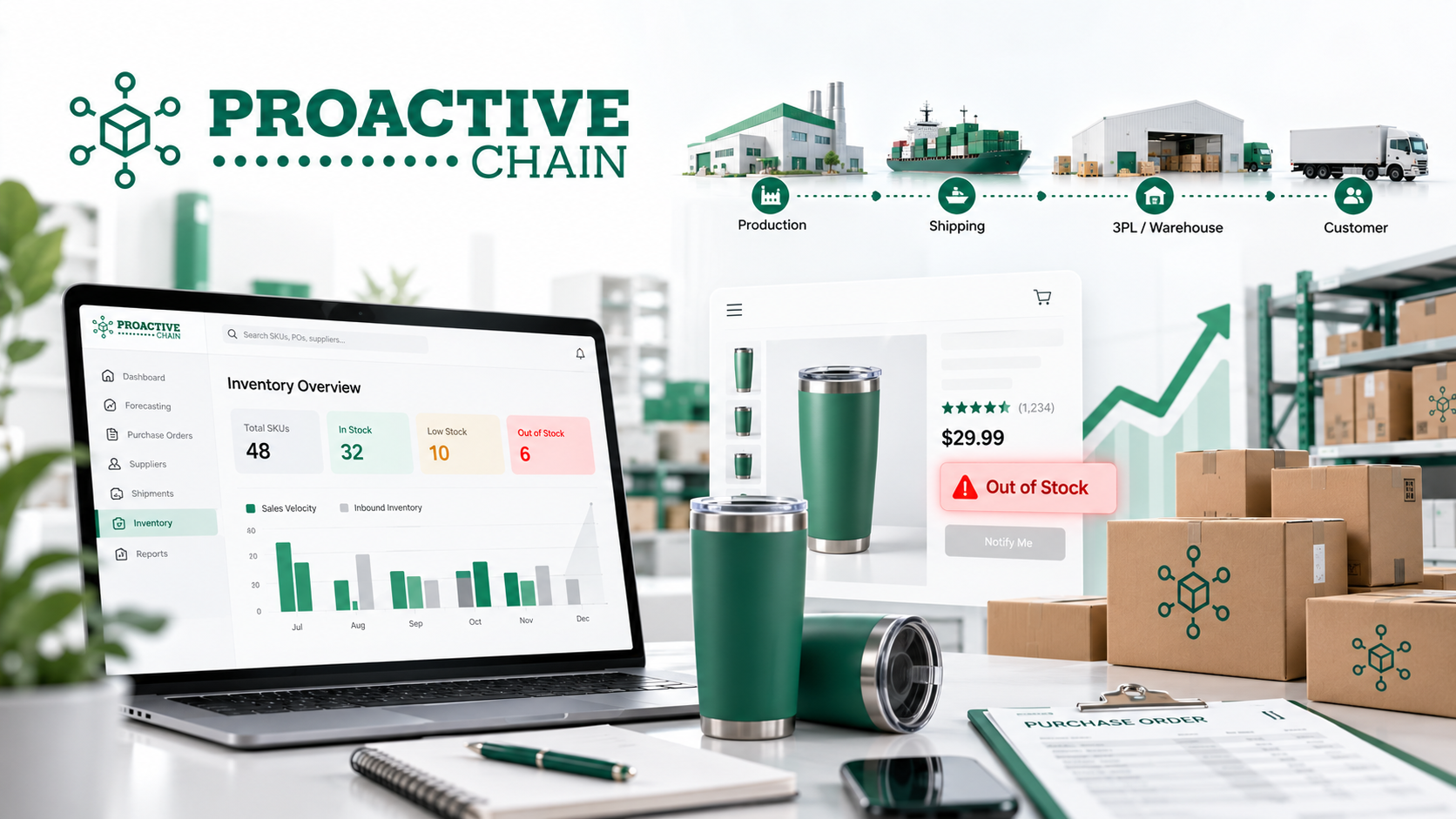
8. Build an Inventory Risk Dashboard
Founders should not need to open ten spreadsheets to understand whether inventory is healthy.
At minimum, your inventory view should show:
- Current inventory
- Average sales velocity
- Forecast sales velocity
- Weeks of cover
- Reorder point
- Safety stock
- Open purchase orders
- Expected inbound date
- Supplier lead time
- Stockout risk
- Excess inventory risk
The goal is simple:
You should know which SKUs require action before they become emergencies.
The Hidden Cost of Ecommerce Stockouts
Lost sales are only the most obvious cost.
A stockout can also create:
Wasted Advertising Spend
Marketing campaigns may continue driving traffic to products that are unavailable.
Emergency Air Freight
Brands frequently respond to inventory shortages by moving goods by air instead of ocean freight.
That can protect revenue, but dramatically increase landed cost.
Lower Amazon Rankings
Running out of inventory can interrupt sales velocity and organic marketplace performance.
Customer Frustration
Customers may buy from a competitor instead of waiting for your inventory to return.
Poor Cash Decisions
Emergency purchasing often means larger deposits, rushed freight decisions and less control over working capital.
Founder Time
Perhaps the most overlooked cost is management attention.
When inventory planning fails, founders end up personally chasing suppliers, comparing freight options, checking warehouses and deciding which SKU receives limited inventory.
That is operational time that could have been spent growing the business.
When Should You Reorder Inventory?
There is no single reorder point that works for every ecommerce brand.
The right time to reorder depends on:
Forecast demand + total replenishment lead time + inbound inventory + safety stock + supply-chain risk
For a fast-growing brand, those variables need to be reviewed continuously.
A reorder point calculated six months ago may no longer be useful today.
A Better Ecommerce Replenishment Process
A stronger process looks like this:
1. Forecast demand
Use recent sales velocity while adjusting for seasonality, promotions and abnormal periods.
2. Calculate inventory coverage
Determine how long current inventory will last.
3. Review inbound inventory
Identify open purchase orders and realistic arrival dates.
4. Compare coverage against replenishment lead time
Determine whether new inventory will arrive before existing inventory runs out.
5. Apply the appropriate safety buffer
Account for uncertainty in demand, production and transportation.
6. Trigger the purchase order early enough
Do not wait until inventory reaches an arbitrary minimum quantity.
7. Update the plan every week
Ecommerce changes too quickly for static quarterly inventory planning.
How ProActiveChain Helps Ecommerce Brands Prevent Stockouts
For growing brands, inventory planning becomes increasingly difficult as the number of SKUs, suppliers, warehouses, channels and countries increases.
ProActiveChain acts as an outsourced supply chain team for ecommerce brands, connecting forecasting, supplier management, purchase orders, freight and inventory planning into one operating process.
Instead of waiting for inventory problems to become emergencies, we help brands identify risk earlier and take action.
That includes:
- Demand forecasting
- Inventory planning
- Reorder planning
- Purchase order management
- Supplier lead-time tracking
- Freight coordination
- 3PL inventory oversight
- Supply-chain reporting
The objective is not simply to hold more stock.
It is to keep the right inventory available at the right time without unnecessarily tying up cash.
Frequently Asked Questions
What causes stockouts in ecommerce?
Common causes include inaccurate demand forecasts, late purchase orders, supplier delays, freight delays, insufficient safety stock, rapid sales growth and poor visibility over inbound inventory.
How can ecommerce brands prevent stockouts?
Brands can reduce stockouts by forecasting demand regularly, calculating reorder points using real lead times, holding appropriate safety stock, tracking purchase orders and monitoring weeks of inventory cover.
How do you calculate a reorder point for ecommerce?
A basic formula is:
Reorder Point = Demand During Replenishment Lead Time + Safety Stock
Growing brands should use forecast demand rather than relying only on historical averages.
How much safety stock should an ecommerce brand hold?
There is no universal number. Safety stock should reflect demand volatility, supplier reliability, replenishment lead time, freight risk and the financial impact of running out of the SKU.
How often should ecommerce inventory forecasts be updated?
Fast-growing brands should review inventory frequently, often weekly, because sales velocity, marketing activity, supplier dates and inbound inventory can change quickly.
Can you prevent every stockout?
Not every disruption can be predicted, but better forecasting, supplier visibility, safety stock and replenishment planning can significantly reduce avoidable stockouts and provide more time to respond when conditions change.
Find Your Stockout Risks Before They Cost You Revenue
If you are unsure which products are at risk of running out, where too much cash is tied up in inventory, or whether your current purchase orders will arrive in time, ProActiveChain can review your supply chain.
Claim Your Free ProActiveChain Supply Chain Audit
We will look at your inventory position, forecasting, supplier lead times, purchase orders and inbound shipments to identify where your biggest risks are before they turn into expensive emergencies.